
Reclaimed Materials
Spolia
Spolia (Latin for 'spoils') refers to stone taken from an existing structure and repurposed for new construction or decorative use. This ancient practise involves reclaiming stone that as already been quarried, cut, and built into earlier structures. Historically, material reuse has been widespread across Europe and, in the UK, largely associated with ecclesiastical buildings and monuments.
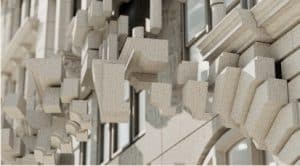 Today, rising awareness of the carbon cost of newly quarried stone is driving renewed interest in dismantling and reusing stone facades. Advances in technology now allow a high level of technical certainty as early as RIBA Stage 2.
With low embodied carbon values of 0.06-0.09 kgCO2e/kg, repurposed stone offers clear environmental benefits. Demand has grown significantly, supported by London planning policy prioritising material reuse and minimal waste.
As the leading specialist masonry contractor in the dismantling and repurposing of existing masonry buildings, we work to realise their greatest potential. With over 30 year of experience and more than 50 masonry buildings successfully dismantled and rebuilt, we are available to discuss your project and explore the most effective and sustainable option for its future.
Paye Spolia Services
At present we have over 5,000 tonne of stone that has been carefully dismantled from redundant and altered
buildings that is available for other projects.

The stone is of known provenance and considered to be low carbon value because it is salvaged for reuse.

Categorised as either conservation or commercial the stone is available for repurposing and reuse for repair
and new build projects.
We offer specialist talks and CPD sessions focused on the assessment, salvage, and repurposing of historic masonry.
Drawing on experience from our first project in 1996, these lectures trace the evolution of technology, legislation, and client requirements
over the past 30 years, supported by practical case studies and first-hand reference material.

Upcoming events:
May 2026 The Stone Collective one day symposium about Structural Stone at the Design Museum’s Stone Demonstrator

Previous events:
Footprint ‘24 Sponsor Lecture May 2024
Stone Collective Petra Kutcha February 2025
Footprint ‘25 Sponsor Lecture May 2025
Stone Federation Monthly Magazine September 2025
Stone Collective Book No2 November 2025
Stone Federation Heritage Lecture November 2025
Recessed Space Lecture series @ 1 Poultry February 2026
FURTHER NEWS:
The Digital Archaeology of Stone:
Where Traditional Craft Meets Modern Technology
The surgical analysis of stone buildings has evolved into digital archaeology—a precise, non-invasive study that respects both material and maker. Traditional methods once relied on destructive sampling, core drilling, and fragment removal to reveal construction techniques. Today, advanced surveying techniques allow us to read a building’s history without physical harm, providing insight into construction methods while identifying the volume of stone suitable for repurposing.
Light Detection and Ranging (LiDAR) laser scanners provides a detailed mapping of the stone surface by emitting light pulses and measuring return times with startling precision. Triangulation, pulse, and phase systems cast geometric nets across stone façades, creating point clouds so detailed they capture subtle undulations left by masons’ chisels when originally constructed. These digital models record surface geometry at millimeter resolution, preserving craftsman ship not only in stone but as precise digital data.
Photogrammetry extends this capability by adding texture and color to geometric measurements. Combined with laser scanning, it produces detailed digital twins documenting every surface variation—cracks, erosion, discoloration—creating archives that are both visually accurate and technically rigorous.
Ground Penetrating Radar (GPR) complements surface-based methods by examining masonry interiors. Like medical ultrasound reading hidden life within a body, GPR sends electromagnetic pulses through stone walls, returning with maps of internal mysteries. Stone thicknesses, voids, brick cores and structural discontinuities reveal themselves as shadows within shadows—technology as divination, reading masonry’s internal poetry with scientific precision.
Together, these tools create comprehensive digital twins functioning as diagnostic instruments and cultural records. They enable the design team to understand the original construction methods, assess structural integrity, and plan interventions with greater certainty. Crucially, they support an approach to repurposing the masonry by identifying the potential within the building as though it is a built quarry being assessed for mining.
This integrated approach has transformed building investigation from invasive testing and approximation into an evidence-based discipline combining scientific precision with cultural stewardship. Designers can now discover repurposing potential within existing buildings, accurately determining original construction techniques. This precision provides certainty for sustainability targets earlier in design processes.
Yet in this technological triumph, we find ourselves paradoxically drawn closer to the human hands that first shaped these stones. Tool marks become immortalized in code, intentions decoded by algorithms that have learned to see with human eyes.
Spolia: Ancient Wisdom for Modern Retrofit

In the vocabulary of architecture, spolia refers to the reuse of building materials from earlier structures
in new construction. The term derives from the Latin spolium, meaning “spoils,” and in antiquity carried
connotations of conquest and appropriation. Yet spolia was never purely symbolic. For ancient builders, marble
columns, finely carved lintels, and quarried stone represented immense value - both material and labour. To
discard them would have been wasteful. Across Rome, Byzantium, and the Islamic world, builders integrated spolia
into palaces, mosques, and civic monuments - part trophy, part resource, and an early expression of sustainable
practice.


Historical Origins

While Rome's Arch of Constantine (315 AD) is often cited as the quintessential example of spolia, the practice was
far more widespread and practical. The Theatre of Marcellus and San Giorgio in Velabro demonstrate spolia at its
most resourceful, with builders reconfiguring architectural elements where different classical orders intermingle
seamlessly.

Ancient builders understood what modern sustainability advocates are rediscovering: finished stone columns, finely
carved lintels, and quarried stone ashlar represent immense value in both material and embodied labour.
The 14th-century Frankish Castle on Paros features column shafts cut down to form circular walling stone - adaptive
reuse with minimal transformation.

Spolia was thus not only a language of power but also a pragmatic response to material scarcity. By embedding fragments
of older structures, builders created both physical continuity and symbolic resonance.

Spolia and the Climate Crisis

Today, the profession faces an analogous challenge. The carbon cost of construction has become untenable: concrete alone
contributes nearly 8% of global CO₂ emissions. Extraction and processing of raw materials intensify climate change while
depleting ecosystems. In this context, spolia is no longer a historical curiosity but a critical strategy for sustainable
design.

Momentum gathered in 2015, when the Mayor of London’s London Plan embedded reuse at the core of the policy. Façade dismantling
and rebuilding became a Trojan Horse for planning approval. Over the last decade, these expectations have matured: planning now
imposes strict expectations on redevelopment carbon costs, while architects explore ways to reshape and reintegrate stone removed
from buildings.

Contemporary Practice

In London, a striking shift in project identity is underway: rather than pursuing wholesale redevelopment, many schemes now prioritise
retrofit, often enhanced by the addition of lightweight floors above existing structures to increase the carbon cost denominator.
Developers are finding creative ways to meet the ambitions of the London Plan, working with what is already there. Weathered industrial brick
is carefully cleaned and re-laid, structural steel is recalibrated to serve new frameworks, and cladding panels are repurposed in contemporary
contexts. These strategies not only extend the life of materials but also significantly cut reliance on virgin resources. Increasingly,
certification systems such as LEED and BREEAM recognize and reward this resourceful approach, embedding a philosophy of reuse—once relegated to
architectural theory’s notion of spolia—into the very mainstream of urban development.

Challenges remain. Heavy materials require transport that can erode carbon savings. Liability and codes often restrict reuse of structural elements.
Designers and clients sometimes prefer visual uniformity, which reused materials seldom provide. Overcoming these barriers demands innovation not
only in engineering, but also in policy, supply chain logistics, and cultural attitudes toward material diversity.

The Problem of 20th-Century Masonry

Adapting early 20th-century masonry illustrates both challenges and opportunities. Many reclaimed stones carry lewis pin holes or rough backs that
prevent a clean second cut. Others were built with rubbed faces and normalized bed joints, creating trapezoidal blocks ill-suited to today’s preference
for cubic units. These irregularities complicate reuse but also reveal the craft traditions of their time. Rather than obstacles, they offer insights
into historic construction and invite more nuanced approaches to repurposing.

Digital Archaeology

Where ancient builders relied on intuition, today’s designers deploy advanced digital tools to evaluate reuse potential.
LiDAR scanning captures geometries at millimeter resolution, recording even the tool marks of the masons.
Photogrammetry overlays texture and color, producing accurate digital twins that register cracks, erosion, and weathering.
Ground Penetrating Radar (GPR) maps volumes, voids and thicknesses without destructive intervention.

Together, these methods create detailed digital records functioning as both diagnostic instruments and cultural archives. They allow teams to understand
original methods, assess structural integrity, and identify volumes of stone available for reuse. Buildings become “constructed quarries,” catalogued for
systematic redeployment.

From Approximation to Evidence

This integration shifts practice from approximation to evidence-based design. With precise data, architects can align reuse strategies with carbon targets
earlier in the process. Risk is reduced, certainty increased, and sustainability claims substantiated.

Academia is already advancing this approach. Harvard’s Long Living Spolia initiative reframes design as archaeology of the future, training students to
anticipate material reuse beyond their projects’ lifespans. At Oxford Brookes, the Latent RADDicals dissertation (2025) explored AI-driven reuse of
decommissioned stone buildings, expanding the digital craft of circular architecture. Such initiatives show how the next generation is embedding stewardship
at the heart of design.

Unlocking the Next Use

Developing a digital twin is therefore a crucial first step in unlocking reuse potential. By capturing geometry, material character, and construction logic,
these models transform demolition waste into a mapped resource.

EU-funded studies in Belgium, the Netherlands, and Germany demonstrate how digital twins combined with systematic deconstruction enable urban mining with
higher recovery rates. Instead of defaulting to downcycling, projects selectively redeploy stone, brick, and concrete, delivering both carbon savings and
financial viability. These cases prove that circular demolition is achievable when supported by the right tools, policies, and collaborative frameworks.

The UK lags behind. Even now, consultants propose crushing stone cladding for terrazzo aggregate as the default - presented as evidence of circularity while
undermining the inherent value of stone. This reductive approach leaves recovery contingent on chance rather than systematic planning. To unlock high-value
reuse, the UK must expand expertise in stone typologies, invest in digital cataloguing from the outset, and embed reuse pathways in procurement and planning
frameworks.

Conclusion: Old Wisdom, New Relevance

As climate pressures intensify, architects and engineers must increasingly design with the resources already around us. Spolia offers more than a method of
material recovery: it is a framework for reimagining the built environment as a living, evolving resource. True resilience lies not in continuous extraction
but in the stewardship of what endures.

Spolia, then, is not just reuse - it is material intelligence. It honours the labour embedded in the past while equipping us to build responsibly for the future.
Stone, among the most inherently circular of materials, demonstrates this principle with particular clarity. What was once the spoils of conquest now becomes the
resource of survival.
Our façade audit service provides a detailed assessment of existing stone façades, focusing on material condition and suitability
for repurposing. Through comprehensive on-site inspections, we evaluate stone type, weathering, fixings, structural performance,
and historic interventions to determine reuse potential.

Using LiDAR and GPR we are able to determine the stone volume treating the building as an urban mine.

The audit identifies defects, durability issues, and remediation requirements, enabling informed decisions on retention, dismantling,
or reworking of stone elements. Clear reporting supports design development, conservation strategies, and circular economy objectives.

Suitable for early project stages, refurbishment, or redevelopment, our service helps protect material value, reduce waste, and ensure
stone façades are responsibly managed for future use.
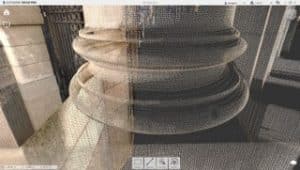
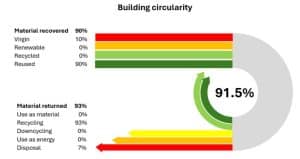
Our material circularity assessment service for stone façades delivers high-accuracy audits as early as RIBA Stage 3, supporting informed design and planning decisions from the outset.

Through detailed surveys, sample analysis, and a thorough review of construction methods, we identify stone types, fixings, condition, and realistic recovery potential. The assessment
quantifies reuse, recycling, and salvage opportunities, providing clear data to guide circular economy strategies, cost planning, and carbon reduction targets.

Early-stage insights reduce risk, prevent unnecessary waste, and protect material value.
Ideal for refurbishment and redevelopment projects, our service integrates sustainability, technical feasibility, and long-term material stewardship.
Our specialist subcontract service provides the careful dismantling of stone façades, backed by over 30 years of hands-on experience. We have a deep understanding of how historic and traditionalbuildings are constructed, allowing us to dismantle stonework methodically while preserving its integrity achieving a 95%+ salvage for reuse. Each project is approached with detailed planning, structural awareness, and respect for original materials. Our skilled team uses proven techniques to minimise damage, ensure safety, and protect surrounding structures. Ideal for conservation, restoration, or redevelopment projects, we deliver reliable, sensitive façade dismantling tailored to the unique character of every building. Contact [email protected] for further details of our services
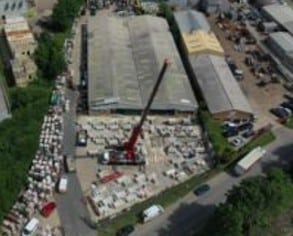
At our three storage facilities, we offer one of the region’s most comprehensive stone storage solutions. Our secure yards can store up to 10,000 pallets
of reclaimed stone sourced from dismantled buildings, carefully catalogued for easy identification and retrieval.
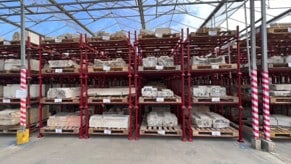
Our storage facilities are linked to primary and secondary cutting facilities, allowing stone to move seamlessly from
storage to processing without transport delays. Primary cutting prepares large blocks and architectural elements, while
secondary cutting delivers precision finishing to project specifications.
This integrated layout maximizes efficiency, reduces handling risks, and ensures consistent quality control from salvage
through to reuse for commercial, heritage, and bespoke construction projects.
All pallets and stones are tagged with a QR code to ensure traceability throughout the dismantle, storage, adaptation and
reinstallation process.
Spolia Stock
Stone
A variety of natural stone, from Portland Stone to Kentish Ragstone, from Marble to Granite

Stone
Travertine Stone Slabs
x80 Unused Travertine stone slabs, 900x600mm

Stone
Cobble Stones
Grey granite cobble stones

Stone
Stone Cras ultricies mi
Praesent adipiscing. Praesent adipiscing. Vestibulum ante ipsum primis in faucibus orci luctus et ultrices posuere cubilia Curae; In ac dui quis mi consectetuer lacinia. Aliquam eu nunc. Nunc nulla.

Stone
Stone Cras ultricies mi
Praesent adipiscing. Praesent adipiscing. Vestibulum ante ipsum primis in faucibus orci luctus et ultrices posuere cubilia Curae; In ac dui quis mi consectetuer lacinia. Aliquam eu nunc. Nunc nulla.

Stone
Stone Cras ultricies mi
Praesent adipiscing. Praesent adipiscing. Vestibulum ante ipsum primis in faucibus orci luctus et ultrices posuere cubilia Curae; In ac dui quis mi consectetuer lacinia. Aliquam eu nunc. Nunc nulla.
Stone
Stone Cras ultricies mi
Praesent adipiscing. Praesent adipiscing. Vestibulum ante ipsum primis in faucibus orci luctus et ultrices posuere cubilia Curae; In ac dui quis mi consectetuer lacinia. Aliquam eu nunc. Nunc nulla.
Stone
Stone Cras ultricies mi
Praesent adipiscing. Praesent adipiscing. Vestibulum ante ipsum primis in faucibus orci luctus et ultrices posuere cubilia Curae; In ac dui quis mi consectetuer lacinia. Aliquam eu nunc. Nunc nulla.
Stone
Stone Cras ultricies mi
Praesent adipiscing. Praesent adipiscing. Vestibulum ante ipsum primis in faucibus orci luctus et ultrices posuere cubilia Curae; In ac dui quis mi consectetuer lacinia. Aliquam eu nunc. Nunc nulla.
Brick
We have a range of reclaimed and new bricks in storage available for your project
Brick
London Red Stock
Reclaimed London Red Stock

Brick
London Yellow Stock
Reclaimed London Yellow Stock Bricks

Brick
Battersea Brick
Standard 225 x 112.5 x 75 mm, from the Northcott Brickyard in the Cotswolds, fired for Battersea Power Station. Contact for more details

Brick
Brick Cras ultricies mi
Praesent adipiscing. Praesent adipiscing. Vestibulum ante ipsum primis in faucibus orci luctus et ultrices posuere cubilia Curae; In ac dui quis mi consectetuer lacinia. Aliquam eu nunc. Nunc nulla.
Brick
Brick Cras ultricies mi
Praesent adipiscing. Praesent adipiscing. Vestibulum ante ipsum primis in faucibus orci luctus et ultrices posuere cubilia Curae; In ac dui quis mi consectetuer lacinia. Aliquam eu nunc. Nunc nulla.
Brick
Brick Cras ultricies mi
Praesent adipiscing. Praesent adipiscing. Vestibulum ante ipsum primis in faucibus orci luctus et ultrices posuere cubilia Curae; In ac dui quis mi consectetuer lacinia. Aliquam eu nunc. Nunc nulla.
Brick
Brick Cras ultricies mi
Praesent adipiscing. Praesent adipiscing. Vestibulum ante ipsum primis in faucibus orci luctus et ultrices posuere cubilia Curae; In ac dui quis mi consectetuer lacinia. Aliquam eu nunc. Nunc nulla.
Brick
Brick Cras ultricies mi
Praesent adipiscing. Praesent adipiscing. Vestibulum ante ipsum primis in faucibus orci luctus et ultrices posuere cubilia Curae; In ac dui quis mi consectetuer lacinia. Aliquam eu nunc. Nunc nulla.
Architectural Salvage
Reclaimed and traditional building features, materials and items
Architectural Salvage
Architectural Salvage
Praesent adipiscing. Praesent adipiscing. Vestibulum ante ipsum primis in faucibus orci luctus et ultrices posuere cubilia Curae; In ac dui quis mi consectetuer lacinia. Aliquam eu nunc. Nunc nulla.
Architectural Salvage
Architectural Salvage Cras ultricies mi
Praesent adipiscing. Praesent adipiscing. Vestibulum ante ipsum primis in faucibus orci luctus et ultrices posuere cubilia Curae; In ac dui quis mi consectetuer lacinia. Aliquam eu nunc. Nunc nulla.
Architectural Salvage
Architectural Salvage Cras ultricies mi
Praesent adipiscing. Praesent adipiscing. Vestibulum ante ipsum primis in faucibus orci luctus et ultrices posuere cubilia Curae; In ac dui quis mi consectetuer lacinia. Aliquam eu nunc. Nunc nulla.
Architectural Salvage
Architectural Salvage Cras ultricies mi
Praesent adipiscing. Praesent adipiscing. Vestibulum ante ipsum primis in faucibus orci luctus et ultrices posuere cubilia Curae; In ac dui quis mi consectetuer lacinia. Aliquam eu nunc. Nunc nulla.
Architectural Salvage
Architectural Salvage Cras ultricies mi
Praesent adipiscing. Praesent adipiscing. Vestibulum ante ipsum primis in faucibus orci luctus et ultrices posuere cubilia Curae; In ac dui quis mi consectetuer lacinia. Aliquam eu nunc. Nunc nulla.
Architectural Salvage
Architectural Salvage Cras ultricies mi
Praesent adipiscing. Praesent adipiscing. Vestibulum ante ipsum primis in faucibus orci luctus et ultrices posuere cubilia Curae; In ac dui quis mi consectetuer lacinia. Aliquam eu nunc. Nunc nulla.
Architectural Salvage
Architectural Salvage Cras ultricies mi
Praesent adipiscing. Praesent adipiscing. Vestibulum ante ipsum primis in faucibus orci luctus et ultrices posuere cubilia Curae; In ac dui quis mi consectetuer lacinia. Aliquam eu nunc. Nunc nulla.
Architectural Salvage
Architectural Salvage Cras ultricies mi
Praesent adipiscing. Praesent adipiscing. Vestibulum ante ipsum primis in faucibus orci luctus et ultrices posuere cubilia Curae; In ac dui quis mi consectetuer lacinia. Aliquam eu nunc. Nunc nulla.